

When a friend miscarries, words often fail us. A thoughtful gesture, however, can speak volumes. Giving a sensitive gift for a friend who miscarried isn't about trying to fix their pain, but about quietly acknowledging their loss and showing you're there for them through the silent grief.
More than anything, your presence and a simple act of kindness are what matter.
How To Offer Support When You Don't Know What To Say
Finding the right words after such a profound loss can feel paralyzing. You want to help, but you're terrified of saying the wrong thing. That’s a completely normal fear.
The most important thing to remember is your goal isn't to erase their sadness, but to sit with them in it. A small, tangible gift becomes a physical representation of your support—a message that says, "I see your pain, and I'm not looking away."
Miscarriage is a uniquely isolating experience. It often happens without the public rituals of mourning that come with other kinds of loss, leaving people to grieve alone. But their grief is real, valid, and deeply personal.
It's also far more common than many of us realize. Global estimates show that around 15% of recognized pregnancies end in miscarriage. That means for every four friends who share happy pregnancy news, one will likely face this heartbreak, often in silence.

Acknowledging Their Pain
Your friend isn't just grieving a possibility; they are grieving a child they already loved and a future they had already started to imagine. Acknowledging this reality is one of the most powerful things you can do.
Many women also grapple with complex emotions like guilt and shame, which can make their grief even heavier. Learning more about this can help you respond with greater empathy. A helpful resource for understanding the difference between guilt and shame can offer some valuable context.
The most compassionate thing you can do is validate their feelings without trying to solve them. Simple phrases like, "This is so unfair, and I am so sorry," or "I'm heartbroken for you," are far more comforting than empty platitudes.
Navigating this journey is complex, and everyone’s path is different. As you support your friend, you can also learn more about the emotional stages involved. Our guide on https://hiddenforever.com/blogs/projection-jewelry/how-to-deal-with-grief offers further insights.
Immediate Support Dos and Don'ts
In those first few raw, confusing days, your actions can set the tone. It's easy to misstep with good intentions, so here's a quick guide on what often helps versus what can accidentally cause more hurt.
| Do This (Helpful Actions) | Avoid This (Common Missteps) |
|---|---|
| Simply say, "I'm so sorry for your loss." | Using phrases like, "At least you know you can get pregnant." |
| Offer specific, practical help (e.g., "Can I bring dinner Tuesday?"). | Saying, "Everything happens for a reason." |
| Acknowledge the baby by name if they had one. | Pressuring them to talk or share details before they're ready. |
| Listen more than you speak. | Sharing stories of others who "got over it" quickly. |
Ultimately, your goal is to show up with compassion and let your friend lead. Just being there, quietly and consistently, is often the most profound support you can give.
When words fail, a thoughtful gift can be a quiet, tangible way to show your love. The goal isn't to fix their pain—it's to acknowledge their baby, validate their grief, and offer a small piece of comfort. A well-chosen gift for a friend who miscarried simply says, "I see you, I remember your baby, and I'm here."
The best gifts are always personal. Think about what your friend needs most right now. Is it a way to honor their baby's memory? Is it something for physical comfort? Or is it practical help to get through the day?

Gifts That Create a Lasting Memorial
For many parents, one of the most healing things is to have a way to remember their baby. A memorial gift confirms that their child existed and was loved, no matter how short their time was.
These gifts create a space for remembrance and can become treasured keepsakes.
- Personalized Jewelry: A delicate necklace with the baby’s initial, a significant date, or a tiny footprint can be worn close to their heart. Some pieces even allow for a private projection of an ultrasound photo, creating an incredibly intimate memorial.
- A Custom Piece of Art: You could commission an artist for a simple, beautiful illustration of their family that includes a symbol for the baby they lost, like a single star in the sky.
- Plant a Tree in Their Baby's Name: This creates a living memorial they can visit as it grows. It’s a powerful symbol of life and continuity that can bring a lot of comfort.
Finding the right way to honor such a loss is a delicate process. If you're looking for more gentle ideas, our guide on https://hiddenforever.com/blogs/projection-jewelry/gifts-for-grieving has some additional suggestions.
Gifts That Offer Physical and Emotional Comfort
A miscarriage takes a huge physical and emotional toll. Gifts that focus on comfort and self-care can be a gentle nudge for your friend to look after herself when it feels impossible.
Think of these items as a warm hug in a box—offering solace without asking for anything in return.
The most comforting gifts are those that meet a person in their ache, offering a quiet invitation to rest and heal at their own pace. They don't try to fix the sorrow, but simply hold space for it.
Putting together a small care package is a beautiful way to deliver this kind of comfort.
Creating a Soothing Care Package
Try to include things that appeal to the senses and encourage quiet moments of rest.
- Soothing Herbal Teas: Calming blends like chamomile, lavender, or peppermint can be incredibly grounding. Sometimes, a thoughtful tea gift is the perfect invitation to pause and find a moment of peace.
- A High-Quality Journal and Pen: Writing can be a powerful way to process overwhelming emotions. A beautiful journal gives them a private space to pour out their heart without judgment.
- A Weighted Blanket or Soft Throw: The gentle pressure of a weighted blanket can be very calming for the nervous system, providing a real sense of security and physical comfort.
- Nourishing Snacks: Grief makes even simple tasks like cooking feel exhausting. Easy, nourishing snacks like granola bars, dried fruit, or a bar of high-quality chocolate are always a good idea.
Gifts That Provide Practical Support
In the days right after a loss, just getting through the day can feel monumental. Practical gifts lift a real burden, freeing up your friend's limited energy for grieving and healing.
This is often the kind of support people need most but have the hardest time asking for.
By being proactive with practical help, you show you understand their world has been turned upside down. It’s a real-world way of saying, "Let me handle this, so you can take care of yourself."
Here are a few of the most helpful ideas:
- Food Delivery Gift Cards: A gift card for DoorDash or Uber Eats lets them order what they feel like eating, right when they want it. It removes all the pressure of cooking.
- An Offer to Run Errands: Instead of a vague, "Let me know if you need anything," try a specific text like, "I'm heading to the grocery store, what can I grab for you?"
- House Cleaning Service: Gifting a one-time professional house cleaning can bring a sense of order and calm to their home when they just don't have the capacity to deal with it.
In the end, the best gift is one that comes from the heart. Whether it’s a memorial keepsake, a comforting care package, or the practical relief of a hot meal, your gesture of support will be felt and deeply appreciated.
4. Gifts to Gently Avoid (Even With the Best Intentions)
When you’re trying to support a friend through a miscarriage, your heart is in the right place. But sometimes, even the most well-meaning gifts can unintentionally cause more hurt. It’s a delicate situation, and knowing what to steer clear of is just as important as knowing what to give.
The goal is to wrap your friend in comfort, not accidentally poke at a raw wound. You want to avoid anything that might minimize her loss, rush her healing, or make her feel like you just don't get it.
Anything Baby-Related or for a Future Pregnancy
This is the big one. It might seem obvious, but it's the most common and painful misstep. Steer clear of anything like baby clothes, nursery items, toys, or even books about parenting. Right now, these things are just heartbreaking reminders of the empty space in her arms and her heart.
Similarly, avoid gifts aimed at a "next time," like fertility bracelets, ovulation trackers, or supplements. These can feel like you're suggesting the baby she lost is replaceable, and it puts a subtle pressure on her to "try again" before she's even had a moment to breathe and grieve. We all have ideas on the best gifts for new parents, but this moment calls for a completely different mindset.
The most thoughtful gift will honor the baby she lost, not push her toward a baby she might have one day. The focus has to be on her current grief and the child she is mourning now.
Gifts That Imply It’s Time to “Move On”
Grief doesn't operate on a timeline. That's why gifts that seem to nudge your friend to "cheer up" or "get over it" can feel so invalidating. This isn't the time for generic self-help books about finding happiness, a "fun" night out, or anything with a forced "look on the bright side" vibe.
Your friend’s world has been turned upside down, and she needs the space to be sad. A gift that tries to "fix" her grief can send the message that her feelings are a problem to be solved. They aren't. They're a normal, necessary part of her experience.
- Skip: The standard "get well soon" fruit basket.
- Reconsider: Books on overcoming adversity, unless you know for a fact the content is gentle and speaks directly to baby loss.
- Ask first: Don't plan "fun" distractions. Instead, ask if she'd be up for a quiet walk or just having you sit with her.
True comfort comes from things that allow her to sit with her feelings—like a beautiful journal or a soft, warm blanket. Your presence is the real gift, not forced positivity.
Overly Religious or Spiritual Items
Faith can be a huge comfort for some, but it can also be a source of pain and confusion after a loss. Unless you are 100% certain of your friend’s specific beliefs and how she's leaning on them right now, it’s best to avoid explicitly religious gifts.
Things like angel figurines, crucifixes, or books with heavy spiritual doctrine can feel isolating if her faith has been shaken. Well-meaning phrases like "God has a plan" can be deeply painful. Pregnancy loss is a profound sorrow that touches so many, yet our collective understanding of it is still lacking. While global abortion estimates for 2025 are around 73 million, miscarriages and stillbirths add another layer of often-silent grief. In the U.S. alone, stillbirth affects 1 in 175 births. You can learn more about the global impact of pregnancy loss to grasp the scale of this experience.
If you share a close faith, a simple, heartfelt card letting her know you're praying for her is a much safer and more personal way to show you care.
How to Present Your Gift with Sensitivity
The care you put into choosing a gift is just the beginning. How you give it—the timing, the place, the words you use—is just as important. It’s the final, gentle step that turns a thoughtful item into a true gesture of love and support.
There’s no perfect script for a moment this tender. The most important thing is to let your friend's needs guide you, making sure your gift feels like a warm hug, not an obligation.
Finding the Right Time and Place
Figuring out when to give your gift can feel really tricky. Do you show up right away, or do you give them some space? Honestly, the answer is different for everyone and depends entirely on your relationship and what you know about your friend.
There’s no one-size-fits-all timeline. For some, an immediate gesture is a powerful reminder that they aren't alone in their fresh grief. For others, those first few days are a chaotic blur, and a gift that arrives a week or two later serves as a beautiful signal that you’re still thinking of them after the initial storm has passed.
Here are a few ways this might look in the real world:
- For a close friend you see all the time: You might decide to drop it off in person. A quick, warm hug and a simple, "I'm thinking of you," is often more than enough. The key is not to linger unless you're invited to; they may not have the emotional or physical energy to "host" a guest.
- For a friend who lives far away: Mailing a package can be a wonderful, low-pressure surprise. It lets them open it in their own time and in the privacy of their own space, which can be a real gift in itself.
- When you're just not sure: A quick text can be the perfect solution. Try something like, "I have a little something for you. Is it okay if I leave it on your doorstep this afternoon?" This gives your friend total control and removes any pressure to have a face-to-face conversation if they aren't ready.
Ultimately, your goal is to make it clear that your gift is just that—a gift, with no strings attached and no expectation of a thank-you.
Crafting a Message from the Heart
The note you write is arguably the most meaningful part of the entire gift. This is your chance to put your heart into words, validating their pain and acknowledging their baby in a way that feels genuine. You don't need to be a poet; you just need to be sincere.
Try to acknowledge their baby and their loss directly but gently. Vague platitudes can sometimes feel dismissive, but a simple, honest message shows you see them and you understand the depth of what they're going through.
"There's no good card for this. I'm just so sorry for the loss of your baby." This sentiment, sometimes found in specialized sympathy cards, hits the nail on the head. It admits that words fall short while offering pure, unconditional support.
This visual guide breaks down some of the key things to avoid when choosing a gift or writing your note. It’s a helpful reminder of what not to say.
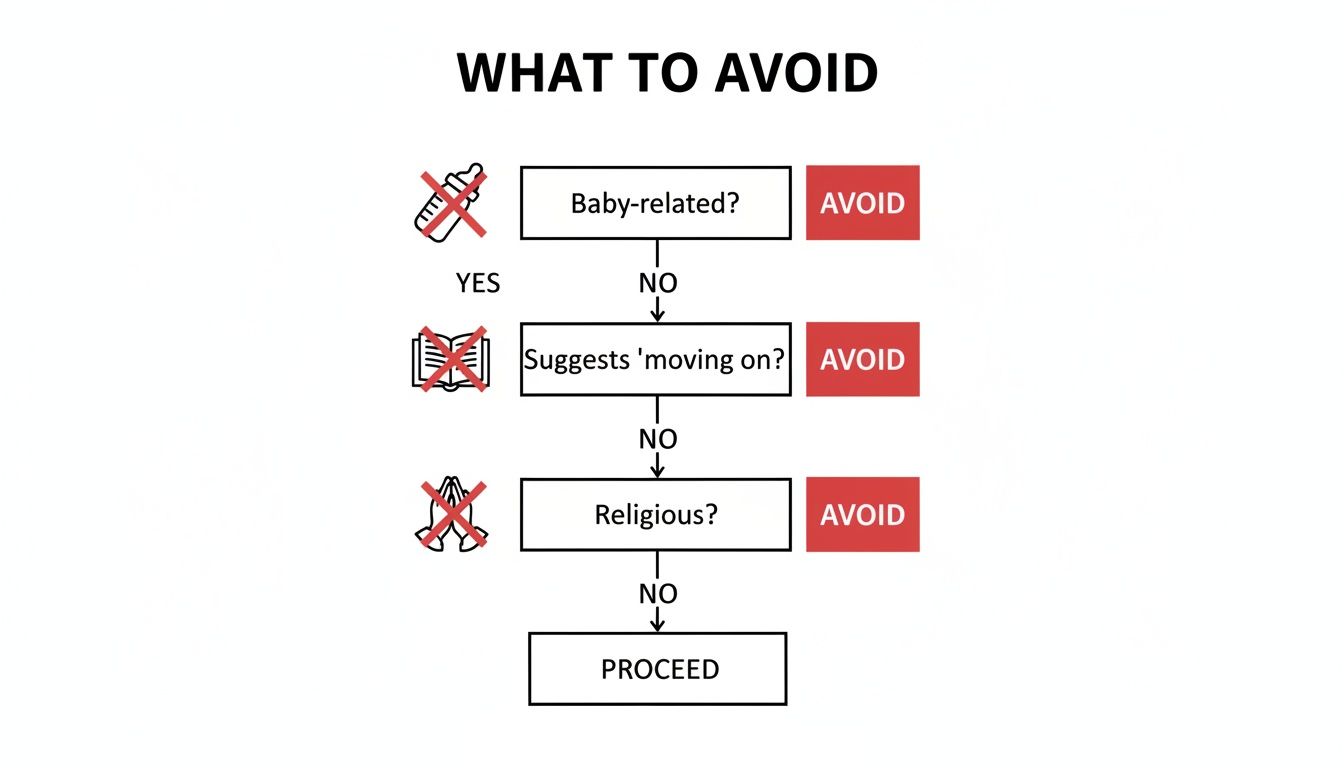
As the chart shows, the best messages focus on simple, present-tense compassion. They don't try to solve the problem or suggest a path forward; they just sit with your friend in their grief.
Sample Messages for Your Card
Staring at a blank card can be intimidating. It's perfectly okay to look for inspiration to get you started, as long as you make it sound like you. If you're really struggling to find the words, our guide on what to write in sympathy cards has even more ideas.
Here are a few simple, heartfelt examples you can adapt to fit your own voice.
| Message Type | Sample Wording |
|---|---|
| Simple & Sincere | "Thinking of you and your family during this impossible time. Holding you all in my heart." |
| Acknowledging the Baby | "We are so heartbroken for the loss of your sweet baby. We're holding so much space for your grief." |
| More Personal (for a close friend) | "There are no words. I love you, and I'm here for absolutely anything. Please don't hesitate." |
| Offering Tangible Support | "I'm so incredibly sorry. I've left a little something for you, hoping it brings a tiny bit of comfort." |
The most powerful messages are often the simplest. Phrases like, "I'm so sorry for your loss," and "I'm thinking of you," have stood the test of time for a reason—they offer comfort without complication.
Your friend doesn't need you to have the perfect words. They just need to know you care. Your thoughtful gift and your heartfelt note are two beautiful ways to show them they aren’t walking this path alone.
Sustaining Your Support Beyond the Initial Gift
A thoughtful gift is a beautiful starting point, a tangible way to say "I'm here." But the grief from miscarriage doesn't have an expiration date. Your steady, quiet presence in the weeks and months that follow is where your support becomes truly invaluable.
This ongoing friendship does something incredibly important: it validates that their baby is not forgotten. Your job isn’t to erase the sadness, but to sit with them in it, showing that their child's memory matters to you, too.
Marking Important Dates and Anniversaries
For a grieving parent, certain days on the calendar can be emotional minefields. Reaching out on these specific dates can transform a day of private pain into one of shared remembrance, reminding your friend they aren't carrying this weight alone.
If you know the dates, make a quiet note for yourself to reach out.
- The Original Due Date: A simple text like, "Thinking of you and your sweet baby today," can mean everything. It validates the parenthood they feel in their heart.
- The Anniversary of the Loss: This day will always be a heavy one. A message like, "Holding you in my heart today as you remember," is a powerful way to show you care.
- Holidays like Mother's Day or Father's Day: These can be particularly gut-wrenching. Acknowledge the potential pain with a gentle, "I know today might be tough. Just wanted you to know I'm thinking of you."
The goal isn't to bring up a painful memory—trust me, they are already thinking about it. Your message just offers a hand to hold, easing the profound isolation that so often comes with these milestones.
The emotional toll of miscarriage is often made worse by how common yet unspoken it is. It's one of the most frequent pregnancy outcomes, with some studies showing up to 30% of all pregnancies end in miscarriage. In 2021, the global rate was over 1,000 per 100,000 population—a staggering number that shows just how many people are navigating this loss in silence. You can read more on the global impact of this experience in this NIH research.
Don't Forget Their Partner's Grief
Partners, and fathers in particular, often become the forgotten grievers. Society tends to cast them in the role of the "strong one," completely overlooking their own heartbreak. Their loss is just as real, and they need support, too.
When you check in, try to include them. A simple, "How are you both holding up?" can make a huge difference. If you're bringing over dinner or a small comfort item, think of something they might appreciate as well. Acknowledging their grief validates their own pain and their role as a parent.
The Power of the "Just Because" Check-In
Grief isn't linear; it comes in waves. Some days are okay, and others are suddenly overwhelming for no clear reason. A random, no-pressure text can feel like a life raft on one of those unexpectedly hard days.
- "Hey, just wanted to say I'm thinking of you. No need to reply."
- "Saw a beautiful sunset and it made me think of you. Hope you're having a gentle day."
- "No questions, just sending a hug through the phone."
These small gestures keep the door open. They show that your support wasn't just a one-time thing but a steady, ongoing presence. Preserving that connection is just as vital as preserving memories. As you help your friend hold onto their precious moments, you might also appreciate our guide on how to preserve old photos, which has tips for cherishing memories of all kinds.
Your beautiful gift was the perfect way to begin. It opened a conversation about love and loss. By continuing to show up, you are giving the most meaningful gift of all: your unwavering friendship on a long and difficult road.
Your Questions Answered: Navigating This Delicate Time
It’s completely normal to feel unsure about what to say or do. You might be worried about saying the wrong thing, but your desire to be there for your friend is what truly matters. Let’s walk through a few common situations you might be wondering about.
How Should I Handle Mother's Day?
For a friend who has miscarried, Mother's Day can be an incredibly painful day. Acknowledging her motherhood can be a profoundly kind gesture, showing her that you see her and recognize the baby she lost.
Ignoring the day completely can sometimes feel like an erasure of her experience. A simple, heartfelt message is often the best approach. You could send a text that says something like, "Thinking of you and your sweet baby today. I know this day might be hard, and I'm sending you so much love." It validates her feelings without demanding a response.
What if My Friend Already Has Living Children?
The loss of this baby is its own unique heartbreak. Having other children doesn't diminish the grief for the child that is gone. Each child holds a different, irreplaceable place in a parent's heart.
It's crucial to avoid phrases like, "At least you have your other kids." This can unintentionally invalidate their pain. Instead, focus your comfort on the baby they just lost, acknowledging that this little one was a cherished part of their family from the very beginning.
Grief isn't a zero-sum game. The loss of a child is always a profound loss. Your friend needs support for this specific heartbreak, separate from her other experiences as a mother.
Is There a "Normal" Amount of Time to Grieve?
Absolutely not. There is no expiration date on grief. It's a journey with unpredictable twists and turns, not a linear path with a finish line. Your friend will have good days and days that feel as raw as the moment it happened, and that could be weeks, months, or even years later.
The most meaningful support you can offer is your steady, patient presence. Let your friend know you’re there for the long haul, without any expectation that they should be "moving on."
- Remember the due date or anniversary of the loss and send a quick "thinking of you" message.
- Create a safe space for them to talk about their baby whenever they feel the need.
- Continue offering practical help, like dropping off a meal or watching their other kids, even weeks later.
Your consistent friendship is one of the most powerful gifts you can give, reminding her that she isn't alone and that her baby is not forgotten.
At Hidden Forever, we believe in honoring every memory. Our projection photo jewelry offers a beautiful, private way to keep a cherished image close to the heart, turning a precious moment into a timeless keepsake. Explore our collection of meaningful memorial gifts at hiddenforever.com.


