

Picture engraving on jewelry is more than just a technique—it's a way to turn a beautiful accessory into a story you can wear. It’s the art of taking a photograph and permanently etching it onto a metal surface. This freezes a moment in time, whether it's a loved one’s smile, a cherished pet, or a memory from a special place.
Essentially, this process transforms a simple piece of metal into a tangible, wearable piece of your life.
Capturing Your Memories on Metal
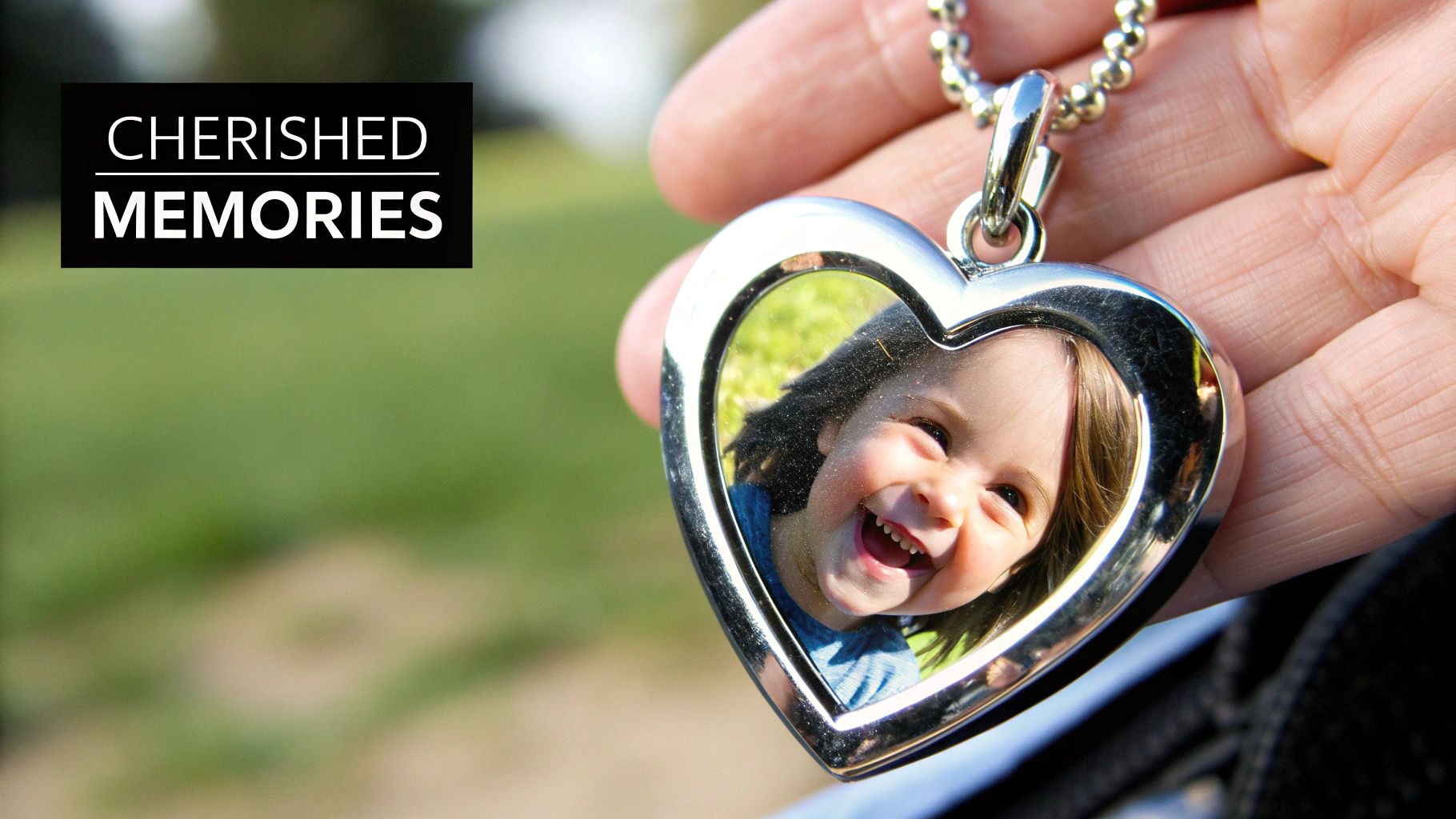
This isn't just about decoration. Picture engraving creates a powerful, lasting emotional connection. It takes a standard gift and makes it profoundly personal, letting you carry a piece of your heart wherever you go. You can think of it as a modern take on the classic locket, but instead of hiding the photo inside, the image becomes part of the jewelry itself.
This guide will walk you through everything you need to know about this amazing craft. We'll look at the technology that makes it possible, help you choose the perfect photo, and show you how to care for your precious keepsake. By the end, you'll see how easy it is to turn your favorite memories into a priceless piece you can treasure forever.
The Emotional Impact of Engraved Photos
The real magic of an engraved photo is its ability to tell a story without a single word. A digital picture can easily get lost in a crowded camera roll, but an engraved image is a constant, physical reminder of a person, a place, or a feeling. It’s a personal touchstone that offers comfort and connection in a way you can actually hold.
This is exactly why picture engraving on jewelry has become such a go-to choice for life's biggest moments:
- Anniversaries and Weddings: Capturing a favorite moment from the big day on a pendant or a pair of cufflinks.
- Memorial Tributes: Keeping the memory of a lost loved one or a beloved pet close to your heart.
- Celebrating Family: Engraving a child’s first drawing or a family portrait onto a bracelet or keychain.
- Marking Milestones: Commemorating graduations, birthdays, or other significant achievements.
The process of creating personalized photo jewelry is a beautiful blend of art and technology, offering a unique way to keep your most treasured moments near. Each piece is a testament to a personal story, making it more than just an accessory—it's a wearable heirloom filled with love.
From Digital File to Lasting Impression
Knowing a little about how it's done can help you appreciate the artistry that goes into each piece. Modern engraving, which is usually done with lasers, translates your digital photo into a series of microscopic marks on the metal's surface.
This method creates an incredibly detailed and permanent image that won’t fade or rub off over time. The final result is a stunning, high-contrast picture that beautifully captures all the fine details of your original photograph.
This guide will demystify the whole process, so you can feel totally confident in creating your own beautiful piece.
The Evolution of Engraved Portraits
The need to carry a picture of someone we love isn't new. It's a deeply human instinct that goes back centuries. Long before we had smartphones in our pockets, people found clever ways to keep portraits and symbols of their loved ones close. This long history of personalizing keepsakes has evolved from delicate hand-carved art to the incredibly precise digital methods we use today.
When you look at modern picture engraving on jewelry, you're really seeing a beautiful blend of timeless emotion and cutting-edge technology. It's a craft that has been perfected over generations, always with the same simple goal: to keep the people we care about near to our hearts.
From Ancient Symbols to Victorian Treasures
While engraving itself is an ancient art, the idea of putting personal images on jewelry really took off in Europe during the Middle Ages. Back then, master goldsmiths would use small hand tools to painstakingly carve everything from family crests to religious icons onto metal.
But the art form truly hit its stride in the Victorian era (1837-1901). As photography became more common, the locket became the must-have piece of jewelry. These small, hinged pendants were perfect for holding a tiny, hand-painted portrait or, later, a small photograph.
A Victorian locket was more than just a piece of jewelry—it was a private little world. It gave people a way to carry an intimate, secret reminder of someone special, hidden from view but always felt. This really cemented our modern love for wearable memories.
Of course, these early pieces were beautiful but fragile. Creating them was a slow, delicate process that required incredible skill. The portraits themselves were also vulnerable to moisture and the simple passage of time.
This infographic shows just how far we've come, drawing a direct line from that early handiwork to today's laser precision.
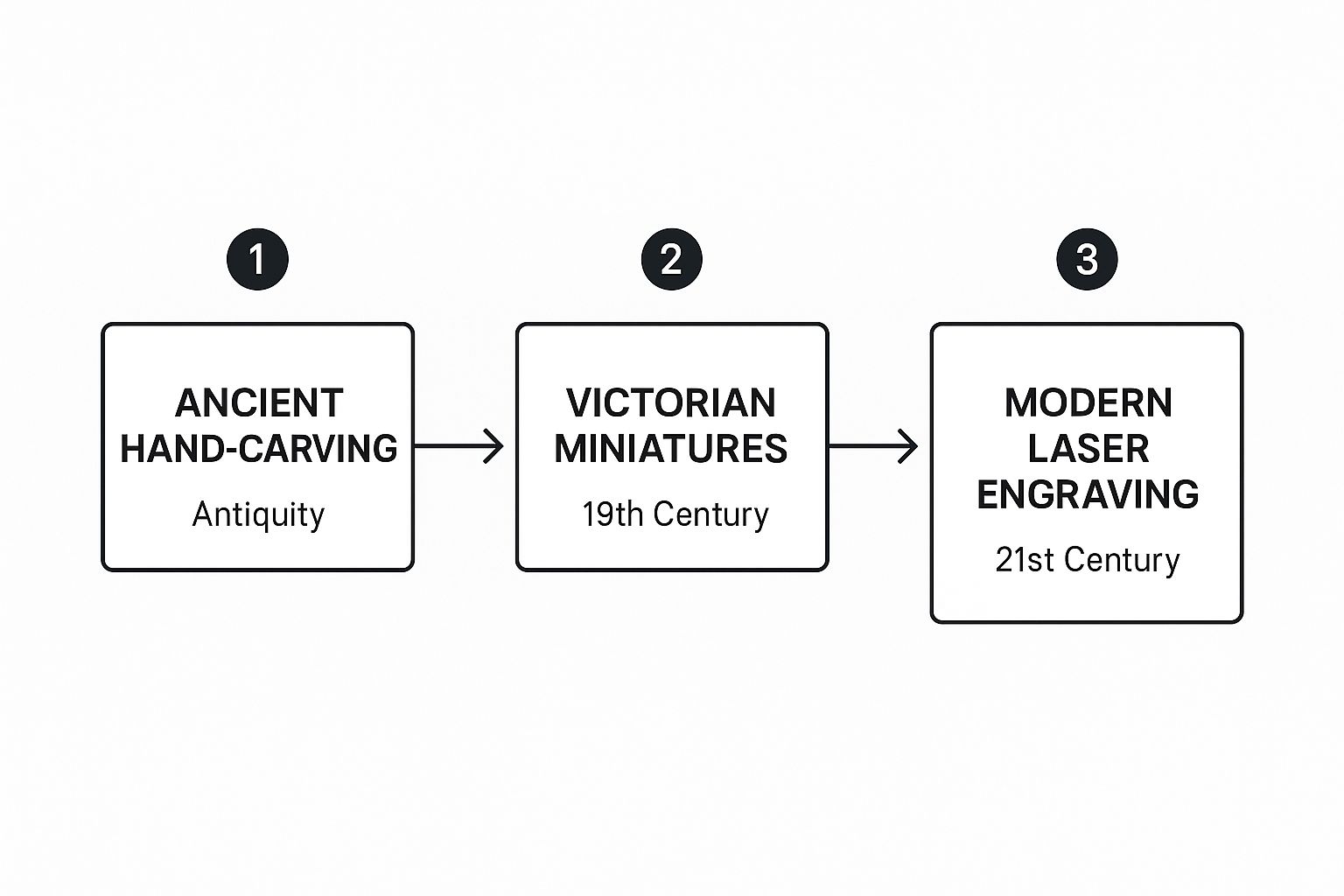
It’s a great visual reminder that while the tools have changed dramatically, the fundamental desire to hold a loved one's image close has stayed exactly the same.
The Dawn of the Laser Engraving Era
The biggest game-changer in the history of personalized jewelry was the move from hand tools to digital lasers. When laser technology became commercially available in the mid-20th century, it completely redefined what was possible. The slow, meticulous work of hand-engraving could now be done by a machine that was faster, more consistent, and capable of capturing unbelievable detail.
It’s like the difference between an artist painting a portrait by hand versus a high-resolution printer reproducing a digital photo. Both capture an image, but the laser provides a level of accuracy and permanence that was simply unimaginable before.
This technological leap completely reshaped the craft:
- Incredible Detail: Lasers work by etching thousands of microscopic dots onto metal, which allows them to recreate a digital photo with amazing clarity, depth, and shading.
- Lasting Permanence: A paper photo inside a locket can get damaged. A laser-engraved image, on the other hand, is physically part of the metal. It won’t fade, peel, or wash away.
- Making it Accessible: Because the process became so much more efficient, high-quality picture engraving on jewelry became affordable for almost everyone, not just the wealthy.
Laser technology didn't just improve on the old ways; it opened the door to entirely new ideas. Take modern photo projection jewelry, which takes the concept a step further by hiding an image inside that can be projected onto a wall. You can learn more about how photo projection jewelry creates unique personalized keepsakes in our other guide.
Every engraved piece made today stands on the shoulders of those early lockets, continuing a beautiful tradition of love and memory with the power of modern tools.
How a Photo Becomes a Keepsake
It’s one thing to see a photo on your screen and another to hold it in your hand, permanently etched into a piece of fine jewelry. The journey from a digital file to a physical keepsake is a beautiful blend of modern technology and careful craftsmanship. It might seem like magic, but there's a precise process that turns the pixels of your favorite picture into a tangible memory.
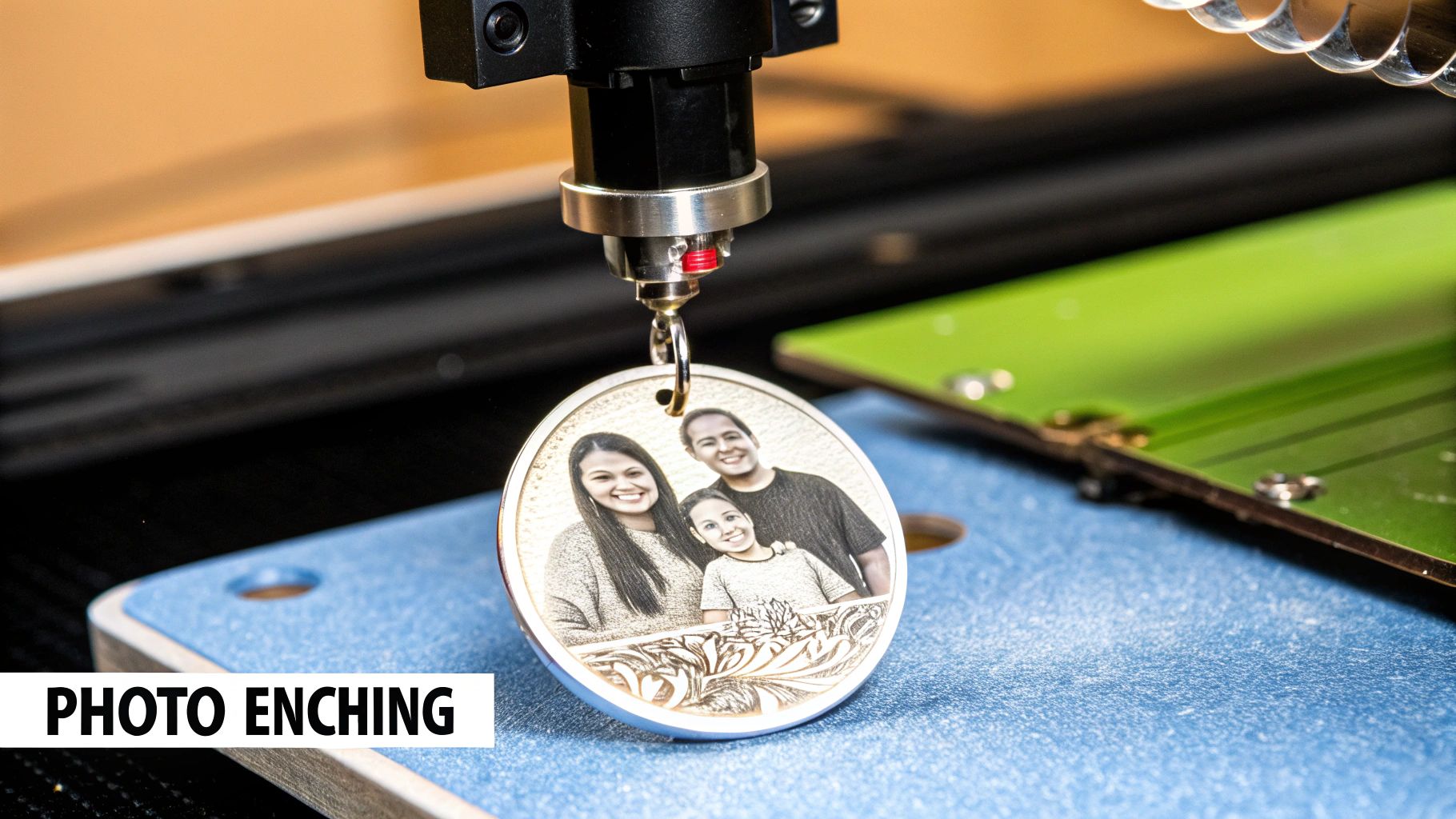
Think of the laser engraver as a high-tech artist's tool. Instead of ink and a canvas, it uses a concentrated beam of light to meticulously recreate your image on a metal surface. It's not just printing on the jewelry; it's making the image a permanent part of the metal itself.
From Digital Image to Engraving Blueprint
Believe it or not, the most important work happens before the laser even warms up. Your photo needs to be perfectly prepared, a step that's far more involved than just clicking "upload." A skilled technician essentially translates your image into a set of instructions the laser machine can follow.
Here’s what goes into prepping your photo for its new life on metal:
- Optimizing Contrast and Brightness: The software is used to punch up the light and dark areas of the picture. This is crucial because the laser creates shading by altering the metal's surface. Strong contrast ensures the final image has depth and clarity.
- Checking Resolution: A crisp, clear photo is non-negotiable. If the original picture is blurry or low-resolution, the engraving will look the same. The goal is to start with the sharpest image possible to get a detailed result.
- Creating the Laser Map: Your photo, likely a JPG or PNG, gets converted into a special file called a bitmap (BMP). You can think of a bitmap as a detailed map that tells the laser precisely where to fire, and with how much power, to replicate every single shade in your picture.
Got an older, maybe slightly damaged photo you want to use? It often requires a little extra care to digitize and restore it first. We have a whole guide on how to preserve old photos to help you get even your most vintage memories ready for engraving.
The Laser Etching Process in Action
With the digital blueprint perfected, it’s time for the main event. The jewelry is carefully secured inside the laser machine, and the settings are fine-tuned for the specific metal—gold, silver, and steel all react to the laser a bit differently.
The machine then gets to work, following the bitmap instructions with incredible precision. The laser beam zips across the surface, making thousands upon thousands of tiny marks. To create darker parts of the image, the laser applies more energy, which creates a deeper or more oxidized mark. For lighter shades, it uses less energy, leaving the metal almost untouched.
It’s this meticulous dot-by-dot approach that allows for stunningly realistic images, complete with subtle shading and gradients. We're not just talking about an outline; this is a full grayscale portrait etched right into the jewelry.
The whole process is completely non-contact; only the beam of light ever touches your piece. This means there's no physical pressure or stress on the jewelry, keeping it perfectly pristine while the image is created. The final product is a breathtaking piece of picture engraving on jewelry that holds your memory in stunning detail.
A Comparison of Jewelry Engraving Techniques
To really get a sense of how amazing modern laser engraving is, it helps to see how it stacks up against traditional methods. Each technique has its place, but when it comes to photos, lasers are in a league of their own.
Take a look at how the three main engraving methods compare:
| Technique | How It Works | Best For | Precision Level | Cost & Time |
|---|---|---|---|---|
| Hand Engraving | An artisan uses sharp hand tools, called burins, to carve a design directly into the metal. | Artistic flair, one-of-a-kind script, and intricate patterns with a human touch. | High, but relies entirely on the artist's skill. Not suitable for photos. | High & Very Time-Consuming |
| Mechanical Engraving | A machine guides a diamond tip or a spinning cutter to etch a pre-set design or text. | Uniform text like monograms, simple logos, and basic patterns. | Moderate. It’s consistent but can't handle fine shading or complex detail. | Moderate & Faster than Hand |
| Laser Engraving | A computer-controlled laser beam vaporizes or alters the surface of the metal dot by dot. | Photorealistic images, intricate graphics, and incredibly fine, detailed text. | Extremely High. It can replicate photos with remarkable clarity and shading. | Low to Moderate & Very Fast |
While hand engraving brings a beautiful, old-world charm, it simply can’t capture the subtle tones of a photograph. Mechanical engraving is a workhorse for simple text but falls short on the complex details needed for a portrait. It's the precision of laser technology that truly makes high-definition picture engraving on jewelry possible, turning a simple photo into an heirloom.
Choosing the Perfect Canvas for Your Memory
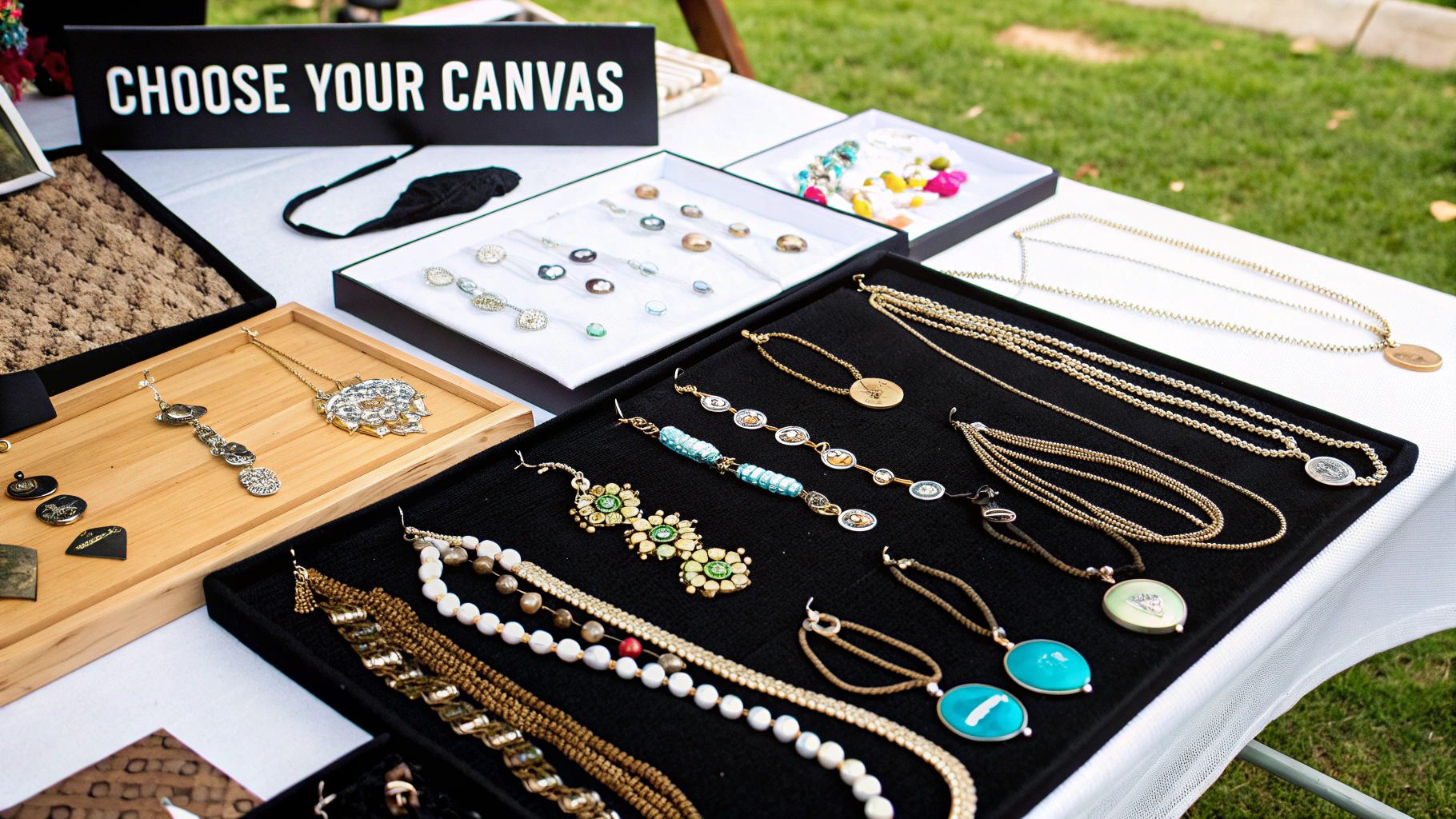
The success of your picture engraving on jewelry really boils down to two things: the piece of jewelry you pick and the photo you want to use. Think of it like a painter choosing their canvas and subject. The right combination can turn a simple idea into a masterpiece, but the wrong one can make all the beautiful details fall flat.
This isn't just about looks. It's about finding the perfect foundation to make sure your memory is captured with stunning clarity and will last a lifetime. Everything from the metal to the quality of your photo plays a huge part in creating a keepsake you'll treasure forever.
Selecting the Ideal Metal and Finish
The metal you choose is quite literally the foundation for your engraved image. Different materials react to the laser in their own unique ways, which completely changes the final look and durability of the engraving. The surface finish is just as important—a smooth, polished canvas is what allows for the sharpest, most intricate results.
Here are the most popular metals for photo engraving and what makes them such great choices:
- Stainless Steel: This is the workhorse of jewelry metals. It's incredibly durable, resists tarnishing, and is very affordable. Its bright, silvery finish provides fantastic high-contrast for black-and-white style photo engravings.
- Gold (Yellow, Rose, and White): A timeless and classic option, gold just feels luxurious. Engravings on yellow and rose gold tend to have a softer, warmer look, while white gold offers a crisp, modern feel that’s a lot like steel.
- Sterling Silver: Known for its brilliant shine, sterling silver creates absolutely beautiful, high-contrast engravings. It is a softer metal, so you’ll need to be a bit more careful to prevent scratches, but its stunning finish makes it a favorite for pendants and lockets.
The finish on the jewelry is a lot like the quality of photo paper. A highly polished, smooth surface will capture every single detail from the laser, giving you a crisp, clear image. On the other hand, matte or heavily textured finishes can swallow up those fine details, so you'll want to avoid them for photo engraving.
Finding the Right Jewelry Style
The style of jewelry you choose dictates how and when your memory is seen. You might want a subtle piece you can wear every day or a larger statement item for special occasions. Luckily, there's a style to fit every personality and purpose.
The tradition of carrying personal images in wearable art goes way back. It has deep roots in the Victorian era, when artisans would craft intricate lockets and brooches to hold tiny, hand-painted portraits of loved ones. These were cherished mementos, and once photography arrived in the 19th century, it allowed for even more realistic images to be kept close.
Today, modern engraving techniques have opened up a world of possibilities far beyond the classic locket.
Popular Styles for Photo Engraving
| Jewelry Style | Best For | Why It Works |
|---|---|---|
| Pendants & Necklaces | Portraits and close-ups | Gives you a prominent, flat surface that's perfect for detailed images. It's the most popular choice for a reason. |
| Lockets | A sentimental surprise | Blends tradition with modern tech. You can engrave the photo on the outside, inside, or both for a classic touch. |
| Bracelets & Charms | Simpler images or pet photos | The smaller surface area is great for single subjects or less complex photos that stay clear even when tiny. |
| Rings (Signet Style) | Initials or simple symbols | While not common for detailed photos, signet rings are perfect for engraving very simple, bold images or family crests. |
Picking the right style is ultimately a personal choice. But if you want the absolute best visual results with a detailed photo, a pendant is almost always the ideal canvas. For more ideas, our guide on custom photo pendants takes a closer look at what makes them such a perfect fit.
What Makes a Photograph Perfect for Engraving
Finally, we need to talk about the photo itself. The quality here is non-negotiable. A laser engraver can only work with the information it's given, so starting with a great image is the most important step. You don't need to be a professional photographer, but keeping a few key things in mind will make all the difference.
Here’s what you should look for in a photo you want to have engraved:
- High Resolution: The image has to be sharp and clear, not pixelated or fuzzy. A higher resolution gives the laser more data to work with, which means more detail in your final piece.
- Good Lighting and Contrast: Find photos with a clear difference between the light and dark areas. An image that's too dark, too bright, or completely washed out will look flat and lose its depth when engraved.
- Clear Subject Focus: The main subject—whether it's a person, a pet, or an object—needs to be in sharp focus. If the subject is blurry in the photo, it will be blurry on the jewelry.
- Uncluttered Background: Simple, clean backgrounds are your best friend. They help the main subject pop. A busy or chaotic background will only distract from the portrait and can make the finished engraving look messy.
When you carefully consider the metal, the jewelry style, and the quality of your photo, you're setting the stage for a truly stunning piece of picture engraving on jewelry. These choices are what ensure your cherished memory isn't just preserved, but showcased beautifully for years to come.
Why Personalized Jewelry Is More Popular Than Ever
In a world of mass-produced everything, we're all looking for something that feels uniquely ours. This search for connection and individuality is shaking up the jewelry world, with more people than ever turning away from generic, off-the-shelf items. They're choosing personalized pieces that tell a story—their story.
Customization changes a piece of jewelry from something you just wear to something that represents who you are and what you care about. This isn't just a fleeting trend; it’s a huge shift in how we think about the things we buy. And at the heart of it all is picture engraving on jewelry.
The Craving for Self-Expression
At its core, this movement is all about self-expression. Jewelry has always been a way to show off your style, but today's customization options take that to a whole new level. An engraved necklace or bracelet becomes a wearable story—a tiny snapshot of a perfect day, a tribute to someone you love, or a mark of a huge personal achievement.
It's about making a statement that is 100% you. Instead of wearing a design that thousands of other people have, you get to create something that’s tied directly to your life. That personal touch is what turns a simple accessory into a treasured keepsake.
The rise of personalized items reflects a fundamental shift in consumer behavior. People no longer want to just buy products; they want to co-create them. This collaborative process makes the final piece infinitely more valuable because it contains a piece of the owner's identity.
Making Connections Through Gifting
There’s a special kind of magic in a personalized gift. Handing someone a piece of jewelry with a meaningful photo engraved on it transforms the entire act of gift-giving. It’s no longer just a transaction; it's a way of saying, "I see you, I care about you, and I took the time to create something just for you."
This is especially powerful when it comes to honoring those we've lost. For someone navigating grief, a piece of personalized remembrance jewelry offers a tangible bit of comfort, a way to keep a cherished memory physically close. It’s a beautiful, constant reminder of a bond that never really fades.
The market data backs this up. The global personalized jewelry market was valued at around USD 42.5 billion in 2024 and is expected to keep climbing. This growth is fueled by people who want their purchases to mean something more than the price tag.
The Role of Technology and Social Media
Let's be honest: none of this would be possible without modern technology. Online shops make it incredibly easy to upload a photo, see a preview of your design, and order a completely custom piece right from your couch. The process is simple, accessible, and has opened up the world of custom jewelry to everyone.
At the same time, platforms like Instagram and Pinterest are a huge source of inspiration. People proudly share their unique engraved creations, showing off what's possible and sparking ideas for others. This digital word-of-mouth has helped turn picture engraving on jewelry from a small niche into a massive industry built on celebrating individual stories.
How to Protect Your Engraved Jewelry
An engraved piece of jewelry isn't just another accessory. It's a wearable memory, a tiny, tangible piece of your story. Protecting that investment—both the sentimental and the financial—is actually pretty simple. It just takes a few good habits to keep that special image looking as crisp and clear as the day you got it.
Proper care is about more than just looks; it preserves the delicate details of your picture engraving on jewelry and keeps the metal itself safe from wear and tear.
Gentle Cleaning for Lasting Clarity
Life happens. Over time, things like skin oils, dust, and lotions can build up, dulling your jewelry's shine and hiding the fine lines of your engraved photo. The absolute worst thing you can do is get aggressive with cleaning. A gentle touch is always the right move.
For most common metals like sterling silver, gold, and stainless steel, this simple process works wonders:
- Mix a mild cleaning solution: A few drops of basic, gentle dish soap in a bowl of warm water is all you need. Stay away from anything with harsh chemicals, ammonia, or bleach.
- Give it a quick soak: Let your jewelry rest in the soapy water for a couple of minutes. This will help loosen any built-up grime without you having to scrub.
- Use a soft touch: Gently wipe the surface with a soft, lint-free cloth. If you need a little more help, an extra-soft baby toothbrush works great, especially around the engraved spot.
- Rinse and dry completely: Run the piece under some cool water to rinse away the soap, then pat it totally dry with another soft cloth before you put it away.
That's it. This simple routine will bring back the sparkle without damaging the beautiful artwork.
Smart Habits for Everyday Protection
Honestly, the best way to keep your jewelry safe is to prevent damage from ever happening in the first place. This just means being a little more mindful about when and where you wear it.
A few easy rules will go a long way:
- Take it off before getting wet: Chlorine from swimming pools and salt from the ocean are tough on precious metals. It's always a good idea to remove your jewelry before you take a dip.
- Put it on last: Think of your engraved piece as the final touch. Lotions, perfumes, and hairsprays have chemicals that can cause buildup and tarnish, so apply all those products first.
- Store it safely: When you’re not wearing it, keep your jewelry in a soft pouch or a lined box. This is the easiest way to stop it from getting scratched by your other pieces.
Think of your engraved jewelry like a cherished photograph in a beautiful frame. You wouldn't leave that photo out in the sun or let it get wet, right? The same logic applies here. Proper storage protects both the frame (the jewelry) and the picture (the engraving).
By making these simple habits part of your routine, you’re ensuring your personalized keepsake stays a beautiful, clear reminder of the memory it holds for years and years to come.
Here are some of the most common questions we get about picture engraving on jewelry. It's completely normal to have a few questions before you commit a special memory to metal. Understanding a bit more about how it all works, from how long it lasts to what kind of photo to use, will help you feel confident in the process.
Let's walk through the big questions so you know exactly what to expect.
How Long Will My Engraved Photo Last?
This is usually the first thing people want to know, and for good reason. The simple answer? A lifetime.
Because the laser physically carves the image into the metal, it becomes a permanent part of the jewelry. It’s not ink or a print that sits on the surface. That means your image will not fade, peel, or rub off, no matter how often you wear it.
Of course, if you were to wear it every single day for 50 years and it was constantly rubbing against something, the finest details might soften over time. But with normal, everyday wear and basic care, your engraved photo is an heirloom in the making.
A laser engraving isn't like ink on a page; it's a memory carved in metal. It becomes a permanent part of the jewelry's structure, ensuring your moment is preserved with the same strength as the piece itself.
What Kind of Photo Gives the Best Results?
The final result is only as good as the photo you start with. This is probably the single most important part of the whole process. For a truly stunning picture engraving on jewelry, you'll want a photo that has a few key things going for it:
- High Resolution: Start with a clear, crisp digital photo. If it looks blurry or pixelated on your screen, it will look soft and undefined when engraved.
- Good Contrast: A photo with a nice balance of light and dark areas is perfect. Images that are too dark or completely washed out tend to look flat once they're etched into the metal.
- Simple Backgrounds: A clean, uncluttered background really makes the person or pet in the photo pop. Busy backgrounds can sometimes distract from what's most important.
Honestly, a well-lit, in-focus portrait is almost always your best bet for a beautiful and timeless piece.
Does the Engraving Process Damage Jewelry?
Not at all. I know it sounds like it could be a harsh process, but it's incredibly gentle and safe for your jewelry.
Laser engraving is a non-contact method, which means the only thing that actually touches the metal is a highly focused beam of light. The laser is so precise that it only affects the very top surface of the metal without compromising the piece's strength or structure. It just changes the texture in a very controlled way to create the image, leaving your jewelry perfectly intact.
At Hidden Forever, we specialize in turning your most precious memories into stunning, wearable art. Our expert engraving process ensures every detail is captured with clarity and permanence.
Discover our collection and create your own personalized photo jewelry today at Hidden Forever