

When you hear the term "artisan jewelry," what comes to mind? For many, it's the image of a skilled craftsperson, hunched over a workbench, carefully shaping a unique piece by hand. That's the heart of it. Unlike items that roll off a factory assembly line by the thousands, each piece of artisan jewelry tells a story—a story of skill, passion, and creativity.
Think of it like the difference between a mass-produced print and an original painting. One is a copy, but the other carries the artist's direct touch and vision.
So, What Exactly Is Artisan Jewelry?
At its core, artisan jewelry is wearable art. It’s far more than just an accessory. The whole concept rests on three simple but powerful ideas: a truly original design, meticulous hand-craftsmanship, and the personal story embedded in every single piece. It’s all about the intimate connection between the maker, the materials they choose, and the final creation you get to wear.
This image really captures the essence of what goes into an artisan's work.
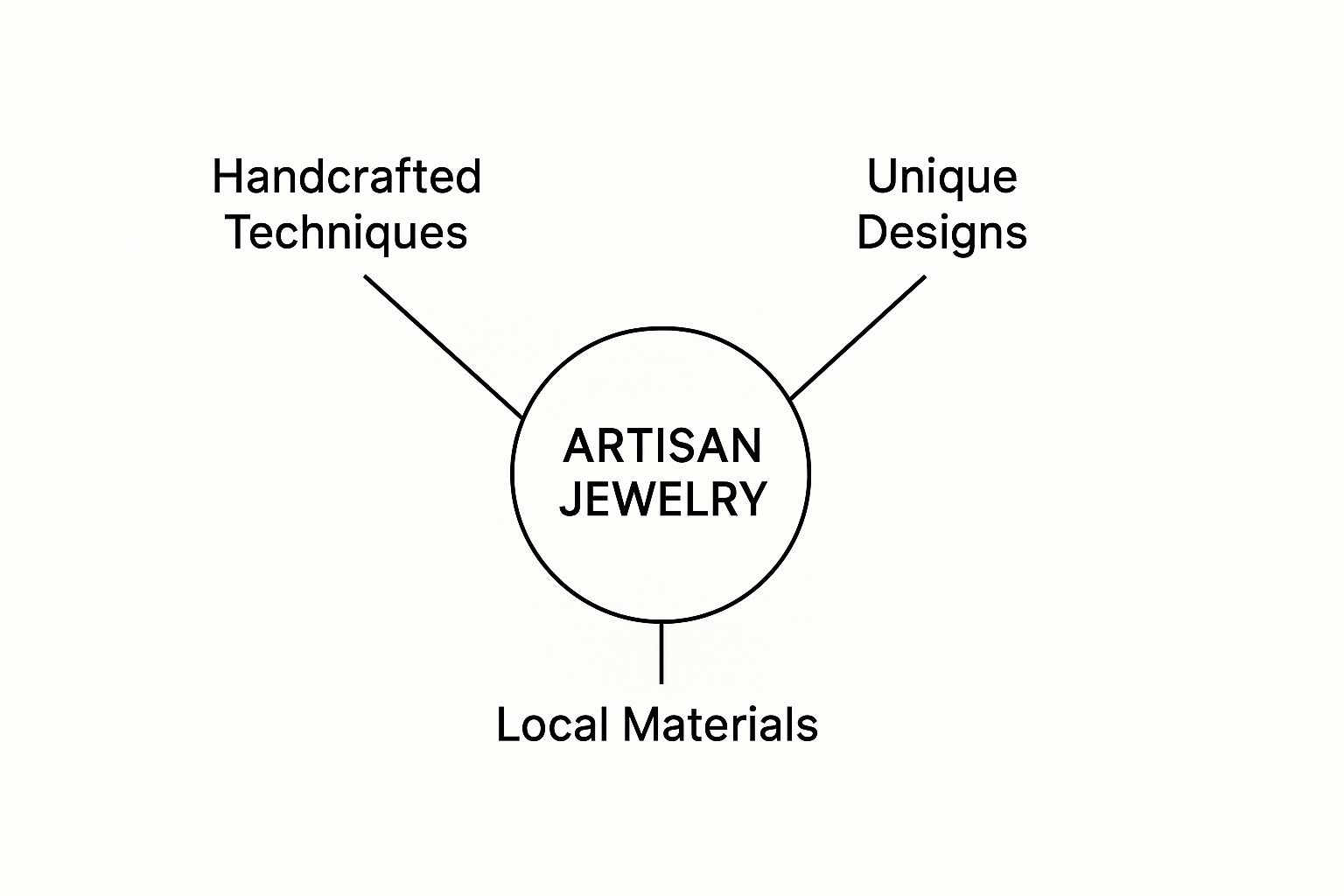
As you can see, it's the blend of hands-on skill, one-of-a-kind design, and thoughtful material selection that gives authentic artisan jewelry its soul.
The Human Touch In Every Piece
The most defining element is, without a doubt, the "human touch." Artisan jewelers rely on traditional, hands-on techniques—skills that have often been passed down through generations or perfected over years of dedicated practice. We're talking about things like hand-forging metal, weaving intricate wire wraps, or carefully setting each gemstone without the help of automated machines.
Because every step is manual, no two pieces can ever be perfectly identical. You might spot a tiny tool mark or a subtle variation in a hammered pattern. These aren’t mistakes. They're the fingerprints of the creative process, the beautiful proof that a real person poured their heart and soul into making it. This idea of embedding personal meaning into jewelry is powerful, and you can see a modern take on it by exploring our guide on what is projection jewelry and the art of hiding secret messages within a piece.
Originality And Limited Production
Another huge difference is originality. An artisan isn't just a maker; they're the designer, too. They don't follow generic, mass-market templates. Instead, they bring their own distinct vision to life, resulting in jewelry that pops with creativity and character.
This commitment to originality naturally means that pieces are made in very small batches or, more often, as completely one-of-a-kind items. You’re not just buying another necklace or ring; you're acquiring a limited-edition work of art.
Artisan Vs. Mass-Produced Vs. Fine Jewelry At A Glance
To really appreciate artisan jewelry's unique place, it helps to see it side-by-side with the other major categories. This table breaks down the key differences at a glance.
| Characteristic | Artisan Jewelry | Mass-Produced Jewelry | Fine Jewelry |
|---|---|---|---|
| Production Method | By hand, one piece at a time | Automated, assembly-line production | Can be handmade or machine-assisted |
| Design | Unique, original, artist-driven | Standardized, trend-focused | Classic, often traditional designs |
| Uniqueness | Each piece is one-of-a-kind or limited | Thousands of identical pieces | Uniform, consistent quality |
| Story | Direct connection to the artist | Brand-focused, no personal story | Focus on material value (e.g., carats) |
| Primary Value | Craftsmanship, originality, story | Affordability and accessibility | Precious materials and brand name |
As you can see, the value of artisan jewelry comes from its soul—the story, the skill, and the originality—while mass-produced jewelry prioritizes accessibility, and fine jewelry emphasizes the inherent value of its materials. Each has its place, but only one offers a direct connection to the artist's hands.
The Rich History of Handcrafted Jewelry
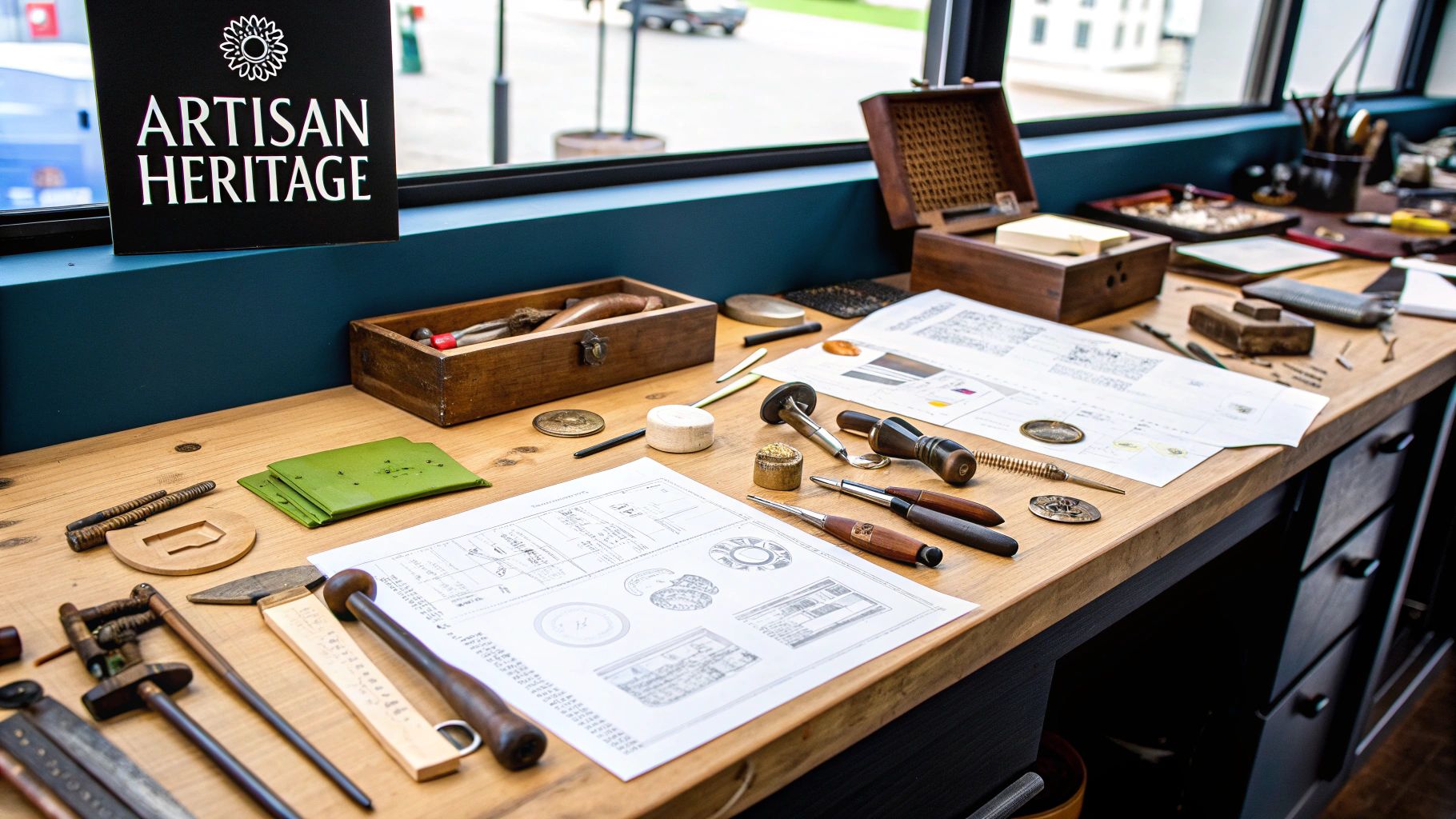
The love for handcrafted jewelry isn't new; it’s a story as old as humanity itself. When you wear a piece of artisan jewelry, you’re not just wearing an accessory—you're connecting to a tradition that started thousands of years ago. To really get what makes your favorite piece so special, it helps to understand its incredible journey.
Long before we had money, handmade ornaments were a big deal. In ancient places like Egypt and Mesopotamia, jewelry wasn't just for looks. It was a way to communicate everything from wealth and social standing to spiritual beliefs and even protection from evil spirits.
These early treasures were crafted from whatever nature provided: shells, bones, beautiful stones, and precious metals. Every single piece was shaped by hand, giving it a personal touch and cultural weight that a factory assembly line could never hope to match.
Turning Points in Jewelry History
As societies grew and changed, so did the art of making jewelry. Certain eras were so creative that their styles and techniques still inspire artisans today. These moments weren't just about fleeting trends; they were full of meaning and artistry.
Some of the most important periods were:
- The Victorian Era (1837-1901): This time was all about sentiment. Jewelry was deeply personal and symbolic, often featuring intricate lockets to hold a strand of hair or miniature portraits. It was the language of love, mourning, and romance.
- The Art Nouveau Period (1890-1910): Tired of rigid, industrial design, Art Nouveau artists looked to nature. They created flowing, organic jewelry inspired by flowers, insects, and graceful lines, often using enamel and horn to bring their visions to life.
- The Arts and Crafts Movement (1880-1920): This was more than a style—it was a rebellion against soulless, factory-made goods. It celebrated simple, handmade items, putting the skill of the maker far above the cost of the materials. In many ways, this was the true beginning of the modern artisan jewelry movement.
These periods weren't just about fashion. They were about pushing back against a world that was becoming more and more automated and reminding everyone of the value of the human touch.
"The Arts and Crafts movement wasn't just about making things by hand. It was a belief system that honored the skill of the individual creator and the inherent beauty of natural materials, setting the stage for how we define what is artisan jewelry today."
From Rebellion to Renaissance
The core ideas of the Arts and Crafts movement—truth to materials, visible handiwork, and original design—are the very same principles that define artisan jewelry today. It created a clear alternative to mass-produced uniformity, an idea that only grew stronger throughout the 20th century.
Later, the studio jewelry movement of the mid-20th century saw artists treating jewelry like sculpture. They experimented with everyday materials and bold, expressive forms, challenging the very idea of what jewelry could be. They weren't just making accessories; they were creating wearable art. That same innovative spirit is thriving in the workshops of today’s artisans.
So, every handcrafted ring or necklace you see is part of this long, unbroken story. It carries a whisper of ancient symbols, a touch of Victorian romance, the organic feel of Art Nouveau, and the proud, rebellious spirit of the Arts and Crafts pioneers. This rich history is what gives artisan jewelry its soul and timeless appeal.
How to Spot Authentic Artisan Jewelry
Venturing into the world of artisan jewelry can feel like a treasure hunt. With so many options, how do you know you're looking at a genuinely handcrafted piece and not just a clever imitation? The good news is that the jewelry itself holds all the clues. You just need to know where to look.
The biggest giveaway isn't perfection—it's the exact opposite. True artisan jewelry proudly displays the "human touch," and the clearest signs are the subtle imperfections that come from being made by hand. These aren't mistakes. They're the beautiful fingerprints of the creative process.
When you hold a piece, really examine its surface. You might spot faint, uniform marks from a file, a textured pattern left by a hammer, or even a slight asymmetry in a bezel setting. This is the evidence you’re searching for. It proves a person, not a machine, guided every step.
Look for Signs of the Artist's Hand
This is where handmade and mass-produced pieces truly part ways. A machine can churn out thousands of identical items with sterile precision, but it can never capture the one-of-a-kind character that an artist breathes into their work.
Here are a few specific tells to watch for:
- Tool Marks: Gentle texturing from hammering, subtle file lines, or the unique patina around a solder joint are all great signs.
- Unique Variations: If you’re buying a pair of earrings, hold them side-by-side. Are they absolutely identical? Probably not. Those slight differences prove they were crafted individually.
- Asymmetrical Beauty: Many artists embrace organic shapes that a machine would try to "correct." This intentional, imperfect symmetry is a hallmark of handmade design.
These little details are the soul of artisan jewelry. They tell a rich story of time, patience, and skill.
The Maker's Mark and Material Stamps
Beyond the physical tells, authentic artisan jewelry often carries the artist's own signature. This is called a maker's mark or hallmark—a tiny symbol, set of initials, or logo stamped directly into the metal. Think of it as an artist signing their canvas.
This mark is a proud declaration of authorship. It connects the piece directly to the person who made it, and finding one is one of the strongest indicators of authenticity you can get.
Alongside the maker's mark, you should also look for a quality stamp that certifies the metal's purity. For example, a "925" stamp on silver means the piece is genuine sterling silver. Understanding these marks is key, and you can learn more about this common stamp in our guide: https://hiddenforever.com/blogs/projection-jewelry/what-does-925-mean-on-jewelry-unraveling-the-mystery
A maker's mark is more than an identifier; it’s a promise of quality and a permanent link to the artist's story. It transforms a beautiful object into a signed piece of wearable art.
Originality and Limited Production
At their core, artisans are designers. They pour their unique perspective into their work, resulting in pieces that look and feel different from anything you'd find at a big-box store. A truly original design—one that feels personal and fresh—is a key trait of authentic work.
This commitment to originality naturally leads to limited production. Many pieces are entirely one-of-a-kind, while others are made in small, exclusive batches. An artist simply can't handcraft hundreds of identical, intricate pieces. Scarcity is a natural result of the painstaking process.
When you're shopping, ask about the piece. Is it a unique creation? How many were made? A true artisan will be happy to share the story behind their design. This exclusivity is a huge part of the appeal, whether you're looking for rings, earrings, or even distinctive brooches.
By looking for this combination of clues—the perfect imperfections, the artist’s mark, and a truly original design—you can confidently find the real thing and invest in jewelry that carries real artistic value.
Exploring Artisan Materials and Techniques
If you really want to understand artisan jewelry, you have to picture the artist's workshop. This is where the magic happens—where raw materials and age-old skills come together to turn humble elements into something you can wear. It’s a delicate dance of chemistry, physics, and pure artistic instinct, all guided by the creator's hands.
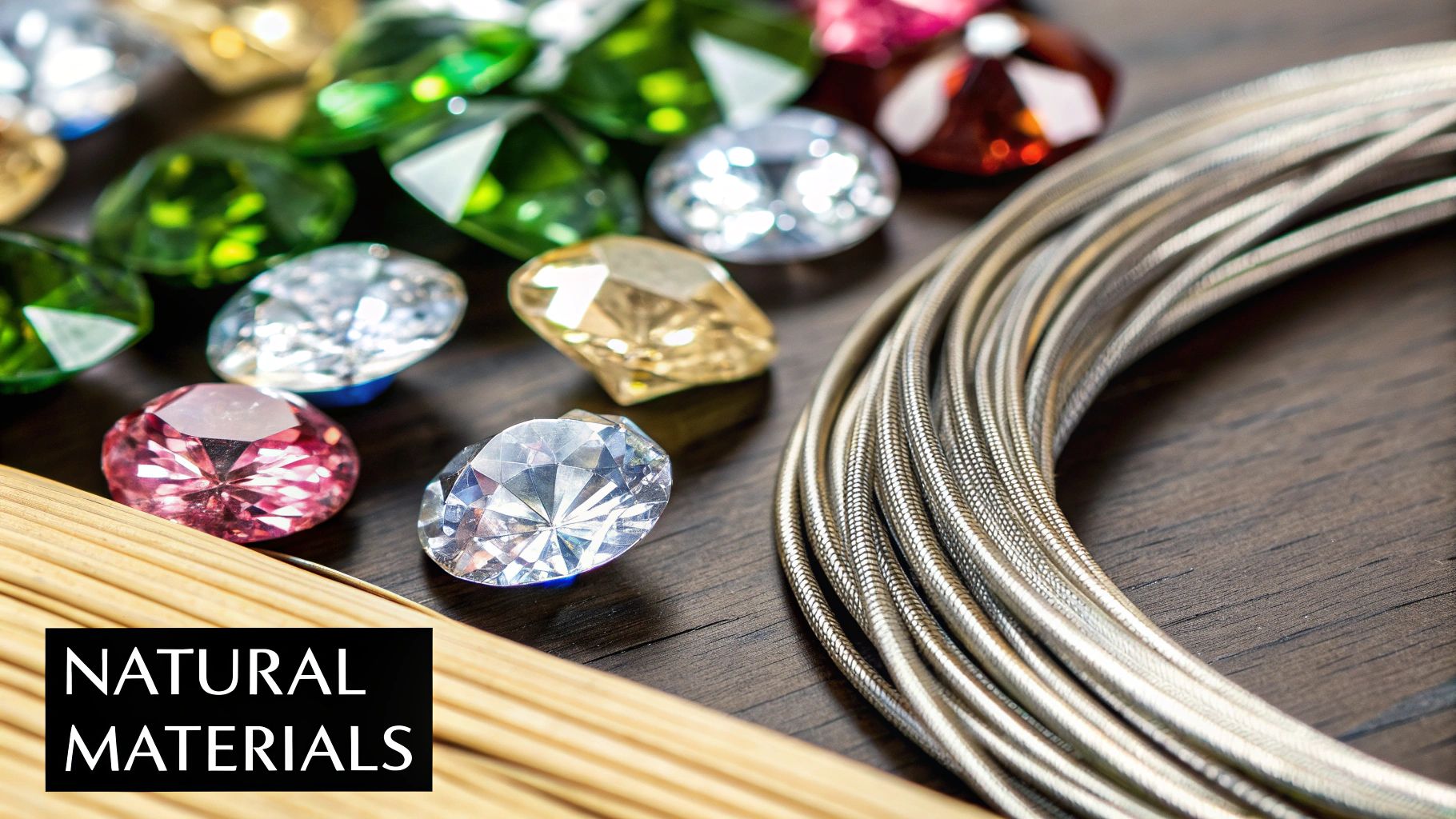
The materials an artisan chooses are the first chapter of a piece's story. Of course, gold and silver are classics, but the world of handcrafted jewelry is so much more imaginative. Many makers today are intentionally choosing sustainable and unconventional materials that give their work a unique voice.
A Palette Beyond Precious Metals
The choice of material is everything. It defines not just how a piece looks and feels, but also its story and its ethical footprint. Artisans tend to pick materials that speak to them personally, which is why the market is filled with such an incredible variety of styles.
You’ll often find materials like:
- Recycled Metals: A lot of artisans put sustainability first, using recycled gold and silver. This cuts down on the environmental harm of new mining and gives old materials a new life, all without compromising on quality.
- Ethically Sourced Gemstones: Responsible creators work hard to make sure their gems are conflict-free and sourced with respect for both people and the planet. This applies to everything from a brilliant diamond to a piece of vibrant turquoise.
- Alternative Materials: This is where things get really creative. Jewelers incorporate all sorts of unexpected elements, like rich hardwoods, sea-tumbled glass, delicate porcelain, or even hand-dyed fabrics to create textures and designs you won’t find anywhere else.
Because of this thoughtful process, buying an artisan piece often means you're supporting a more ethical and sustainable way of doing things. It’s a choice that feels as good as it looks. Deciding between metals is a big part of the journey, and you can dive deeper in our post on sterling silver vs gold-plated jewelry.
The Language of Handcrafted Techniques
Once the materials are in hand, the real work begins. An artisan’s techniques are their unique vocabulary—the methods they use to shape, connect, and finish each piece. These are skills that take years to master, often learned through apprenticeships and performed entirely by hand.
Think of it like brushstrokes in a painting. Every technique leaves its own distinct mark, adding to the final piece and guaranteeing no two are ever truly identical.
The techniques used are not just steps in a process; they are a conversation between the artist and the material. Each hammer blow and delicate twist of wire is a word in the story the final piece will tell.
Here are a few of the foundational techniques you'll see.
Hand Forging and Fabrication
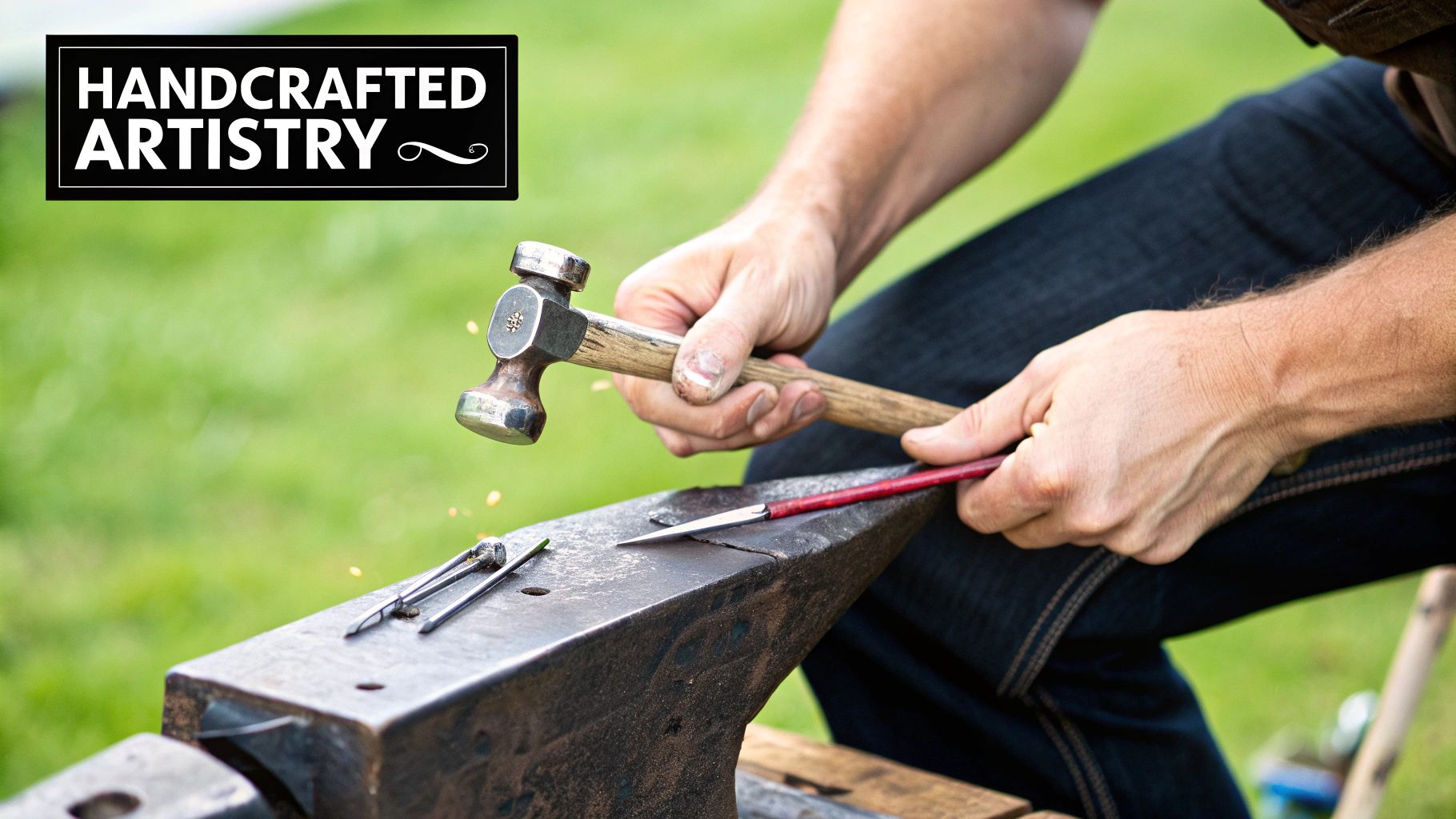
This is the bread and butter of metalsmithing. Hand forging is the process of heating metal and shaping it with hammers and other tools. Fabrication is about building a piece from sheet metal and wire—cutting, bending, and soldering it all together into a three-dimensional object.
It’s a physically demanding process that requires incredible precision. An artist can spend hours hammering a flat sheet of silver into the organic curve of a cuff bracelet or meticulously cutting out a complex pattern with a tiny handsaw.
The Intricate Dance of Filigree and Granulation
Filigree is an ancient technique that looks like delicate metal lace. The artist twists thin threads of metal and solders them into intricate patterns, a task that demands a rock-steady hand and laser-like focus.
Granulation is just as detailed. It involves fusing tiny metal balls, or granules, onto a surface to create texture and design, often without using any solder at all. Both of these techniques produce an ornate beauty that a machine could never hope to replicate.
Lapidary: The Art of Stone Shaping
When an artisan works with a raw gemstone, they're practicing the art of lapidary. This is the craft of cutting, grinding, and polishing rough stones to bring out their inner fire. An artist who is also a lapidarist can cut a stone in a way that best shows off its color, clarity, or unique natural inclusions.
This hands-on approach allows for custom shapes and sizes that are made to fit a specific, one-of-a-kind design. It adds another layer of pure artistry to the jewelry and shows just how much patience and vision it takes to see the potential hiding in a rough stone. Knowing this, you can’t help but appreciate the skill, time, and heart that go into every single piece.
The Real Value of Choosing Handcrafted Jewelry
So, why pick a handcrafted piece over something mass-produced from a big-box store? The answer runs much deeper than just how it looks. When you invest in artisan jewelry, you're not just buying an object—you're getting a small piece of an artist's story, passion, and vision.
Choosing handcrafted is a deliberate move away from the cold, impersonal nature of factory-made goods. You're opting for something with a soul. Every single handmade item carries the energy and intention of its maker, turning a simple accessory into something much more meaningful.
A Deeper Personal Connection
Wearing artisan jewelry just feels different, because it is. You're not just wearing a necklace; you're wearing a piece of art that a real person dreamed up and brought to life with their own two hands. It creates a direct link to a creative spirit—someone who poured their time, skill, and heart into making something beautiful.
That personal touch is something a machine can never, ever replicate. It's what turns a simple piece into a conversation starter or a cherished heirloom passed down through the family. A huge part of this value comes from supporting local artisans and crafters, who are the lifeblood of this creative economy.
The global handmade jewelry market, valued at roughly USD 156.26 billion, proves just how much people are craving this connection. It's expected to grow at 13.3% each year, which shows a clear shift toward buying things with personality and a real story behind them.
Ethical Choices and Sustainable Impact
Opting for artisan jewelry is often a vote for a more conscious and sustainable way of living. Many independent makers make it a priority to use ethical practices that just aren't possible for massive manufacturers. For them, doing good is a core part of their identity.
This ethical mindset shows up in a few key ways:
- Responsibly Sourced Materials: Artisans often go to great lengths to use recycled metals and ethically sourced gemstones. This ensures their work doesn't contribute to environmental damage or unfair labor.
- Reduced Waste: When you work in small batches or create one-of-a-kind pieces, you naturally produce far less waste than mass production, which often relies on making too much.
- Preserving Traditional Skills: Buying from an artisan helps keep ancient techniques like hand-forging and filigree alive. You're ensuring these incredible skills aren't lost to machines.
Buying from an artisan is an investment in a person, a small business, and a more sustainable future. It empowers individual creators and helps preserve the rich heritage of handcrafted artistry.
Heirloom Quality Over Fleeting Trends
Finally, artisan jewelry is built to last. While fast-fashion accessories are designed to be thrown away after a season, handcrafted pieces are created with durability and timeless style in mind. Artists select quality materials and use time-tested methods to make sure their work can stand the test of time.
This means you’re not buying a temporary trinket; you’re investing in a future heirloom. These are the kinds of pieces that will eventually tell your family’s story, like a special necklace given for a milestone birthday. If you're looking for inspiration, our guide to personalized Mother's Day jewelry is full of ideas that last a lifetime.
Ultimately, choosing handcrafted means choosing quality, story, and a legacy of beauty.
How to Buy and Care for Your Artisan Jewelry
Once you've decided to bring a piece of artisan jewelry into your life, the real adventure begins. It’s a two-part journey: finding that perfect piece that speaks to you, and then giving it the care it deserves so it can be treasured for years.
So, where do you find the real deal? Local craft fairs and art markets are fantastic places to start. There’s nothing quite like meeting the makers in person, hearing the story behind a piece, and asking them about their process. That direct connection is part of what makes artisan jewelry so special.
Of course, the internet has opened up a whole new world. The global jewelry industry is massive—valued at around USD 348 billion—and it's changing fast. In the US, nearly 29% of all jewelry sales now happen online, which means artists can reach you from anywhere. You can explore curated online marketplaces that feature vetted artists or, even better, buy directly from an artisan's personal website. To get a better sense of this digital shift, you can find in-depth jewelry industry statistics and trends.
Simple Care for Lasting Beauty
Artisan jewelry is built to last, but its unique character often comes from delicate materials and intricate designs that need a bit of love. Unlike mass-produced items, these pieces aren’t indestructible. The good news? Proper care is simple and goes a long way in preserving the artist's work.
Here are a few golden rules to keep your jewelry looking its best:
- Avoid Harsh Chemicals: Always take off your jewelry before you swim, clean the house, or even put on lotion or perfume. Everyday chemicals can easily tarnish metals and ruin certain gemstones.
- Store It Smartly: Keep your pieces from tangling and scratching each other. A soft-lined jewelry box with dividers or even individual cloth pouches are perfect for protecting delicate surfaces.
- Clean Gently: A quick wipe with a soft, lint-free cloth after wearing is usually enough to remove oils and dust. For a deeper clean, a little mild soap and warm water will do the trick for most pieces.
A key part of loving artisan jewelry is understanding how to care for it. Gentle, consistent maintenance ensures that the piece's story, beauty, and craftsmanship endure for a lifetime.
Tips for Specific Materials
Different materials need slightly different care. Sterling silver, for example, will naturally tarnish with time—that’s just what it does. But it's easy to manage. For step-by-step instructions on making it shine again, check out our guide on how to clean 925 silver.
Stones like turquoise, opal, and pearl are porous and a bit more sensitive. You should never soak them or use harsh cleaners. For these, a simple wipe with a damp cloth is all that’s needed. By following these simple tips, you’ll keep your unique jewelry looking just as stunning as the day you first got it.
Common Questions About Artisan Jewelry
As you start to dive into the world of artisan jewelry, you'll probably find a few questions popping up. Let's tackle some of the most common ones to help you get a better sense of what sets these handcrafted pieces apart.
Is Artisan Jewelry More Expensive?
Not necessarily. It's true that some one-of-a-kind pieces, especially those with rare gems or countless hours of work behind them, can carry a high price tag. However, you'll find that many artisan creations are priced right alongside what you'd see for mass-produced fine jewelry.
The real difference is where the value comes from. When you buy artisan jewelry, your money is going toward uniqueness, exceptional craftsmanship, and the artist's personal story—not just the weight of the metal or a big brand's marketing budget.
How Can I Be Sure Materials Are Ethically Sourced?
The best way is often the most direct: just ask the artist. Most artisans are incredibly passionate about their work and are usually more than willing to talk about their process and where they get their materials.
A huge part of the artisan movement today is about creating with a conscience. Never feel shy about asking where materials come from; a maker who takes pride in their work will be happy to tell you about their sourcing.
Keep an eye out for jewelers who mention using "recycled metals," "conflict-free diamonds," or "ethically sourced gemstones" in their descriptions. Choosing to support artists who are open about this is a great way to make sure your beautiful new piece aligns with your personal values.
Do Handmade Imperfections Lower The Value?
Absolutely not—in fact, it’s the other way around! Those tiny variations, the slight tool marks, are the very soul of artisan jewelry. They're what collectors and admirers look for.
Think of them not as flaws, but as the artist's signature. These so-called "imperfections" are the quiet evidence of a human touch, proving that your piece is truly one-of-a-kind and not stamped out by a machine. They are the marks of authenticity, and they make the piece even more special.
At Hidden Forever, we believe in the power of unique, handcrafted treasures that tell a story. Discover our collection of personalized projection jewelry and turn your cherished memories into wearable art. Explore our designs at https://hiddenforever.com.


